

[Nature] Restoring the Global Environment
The Environmental Impact of Livestock Farming and Agriculture
Japan’s livestock and dairy industries now represent an industrial farming system exceptionally dependent on other countries. In contrast to industrial systems, the shares of animals kept under grazing systems are: dairy cattle, 3%[xiv], beef cattle, 14.1%[xv], pigs, 3%[xvi], laying hens, 2.5%[xvii])。
Large quantities of feed are imported. Self-sufficiency is 78% for roughage, 13% for concentrate feed and 26% for feed overall[xviii])。
Importing feed generates greenhouse-gas emissions and consumes large quantities of oil.
Including overseas feed production and transport, Japan’s industrial livestock farming emits 7.8 kg of CO₂ per kilogram of pork and 23.1 kg per kilogram of beef.[xix]Most imports come from countries on the other side of the world, such as the United States and Brazil, creating high food miles, calculated as the quantity transported multiplied by the distance.[xx])
Producing feed in those countries causes environmental and social problems such as:
• Deforestation of the Amazon rainforest, often called the lungs of the Earth[xxi][xxii]
• Fires associated with forest clearance[xxiii]
• Destruction of biodiversity[xxiv]
• Land degradation[xxv][xxvi]
• Water depletion[xxvii][xxviii]
• Large carbon releases from tillage used to produce forage
• Depletion of fertiliser resources[xxix]
• Displacement of food production for people by feed crops grown to earn foreign currency[xxx]
[xiv]Ministry of Agriculture, Forestry and Fisheries https://www.maff.go.jp/j/council/seisaku/tikusan/bukai/h2603/pdf/05_data5_rev3.pdf
[xv]Ministry of Agriculture, Forestry and Fisheries https://www.maff.go.jp/j/chikusan/sinko/lin/l_siryo/attach/pdf/index-1277.pdf
[xvi]National Association of Towns and Villages https://www.zck.or.jp/site/column-article/20308.html
[xvii]Japan Livestock Technology Association https://jlta.jp/test/wp-content/uploads/2023/12/factual_investigation_lay_h26.pdf
[xviii]Ministry of Agriculture, Forestry and Fisheries https://www.naro.go.jp/laboratory/nilgs/kenkyukai/2331a66b1c3876a4554d8181b474aab8.pdf
[xix]Tokyo Shimbun https://www.tokyo-np.co.jp/article/45380
[xx]Ministry of Agriculture, Forestry and Fisheries https://www.maff.go.jp/j/council/seisaku/kikaku/goudou/06/pdf/data2.pdf
[xxi]Rainforest Foundation Japan https://rainforestjp.com/deforestation/current-state/
[xxii]Esquire News https://www.esquire.com/jp/news/a36872837/amazon-release-more-co2-than-absorb/
[xxiii]BBC News Japan https://www.bbc.com/japanese/features-and-analysis-49443871
[xxiv]WWF Japan https://www.wwf.or.jp/activities/basicinfo/5131.html
[xxv]Reuters https://jp.reuters.com/article/world/-idUSKBN2S70EL/
[xxvi]The Asahi Shimbun GLOBE+https://globe.asahi.com/article/12358808
[xxvii]Graduate School of Agricultural and Life Sciences, the University of Tokyo https://www.a.u-tokyo.ac.jp/topics/topics_20201027-1.html
[xxviii]Excite News https://www.excite.co.jp/news/article/Bizjournal_202106_post_233800/
[xxix]U.S. Grains Council https://grainsjp.org/cms/wp-content/uploads/dlm_uploads/NETWORK_181_web.pdf
[xxx]Institute of Developing Economy https://www.ide.go.jp/library/Japanese/Publish/Reports/InterimReport/pdf/2005_04_11_02.pdf

01
Self-sufficient Animal Feed(Using Wild Plants)
Conventional livestock farming feeds grain to animals. Japan relies on imports for most of its feed grain, contributing to deforestation, desertification and global warming in the countries that produce it.
By becoming self-sufficient in feed using local native wild plants, our Animal Coexistence Satoyama avoids the environmental damage associated with importing livestock feed.
02
Carbon Storage Through Grazing
Grazing can help limit global warming, including through carbon storage. (See our blog for a detailed explanation)


03
Agriculture That Regenerates the Planet
(regenerative agriculture)
In 2015, the UN Food and Agriculture Organization (FAO) warned that around 33% of the world’s soils were degraded and that continuing this trend would seriously affect food production.
Agriculture is also said to account for up to 25% of the carbon dioxide emissions intensifying the climate crisis.
Known in Europe and North America as regenerative agriculture, this approach aims to restore soil fertility and the ecosystems that sustain it across the farm, increase carbon storage in soils, improve farmers’ livelihoods and enhance animal welfare.
As soil microorganisms increase, the nutritional value of the crops also improves.
Practical methods include no-till or reduced-tillage cultivation and the use of compost.
[Sources]
• Patagonia https://www.patagonia.jp/regenerative-organic/
• The Asahi Shimbun GLOBE+ https://globe.asahi.com/article/12358808
• Toyo Keizai https://toyokeizai.net/articles/-/645310?page=3
04
No-till Cultivation
A method of growing crops without ploughing or tilling the soil.
It is attracting attention as an approach that restores soil through natural processes, rethinking conventional agriculture’s reliance on mechanical tillage and chemical fertilisers.
The basic methods include: (1) leaving the soil undisturbed, without tilling; (2) covering the surface with cut grass or cover crops—mulching—because exposed soil is damaged by sun, wind and rain, reducing its ability to retain water and nutrients; and (3) growing a mixture of crops and other plants, including weeds.
[Sources]
• Mynavi Agriculture https://agri.mynavi.jp/2024_02_24_256097/


05
Natural Farming
Currently being written
06
Organic Farming
(Moo-ganic)
Currently being written


07
Eco-friendly Livestock Farming
Grazing in our Animal Coexistence Satoyama qualifies as the environmentally sustainable livestock production supported by Japan’s Ministry of Agriculture, Forestry and Fisheries under its ‘Eco-chiku’ programme [note].
[Note] Ministry of Agriculture, Forestry and Fisheries https://www.maff.go.jp/j/chikusan/kikaku/lin/ecotiku/r6_eco_tiku.html
08
Food Self-sufficiency
Japan’s food self-sufficiency rate was 38% on a calorie basis in 2023. Its low feed self-sufficiency rate—27% in 2023—is said to be a factor holding this down [note]. Feeding local native wild plants can reduce the use of imported feed and improve feed self-sufficiency.
Greater food self-sufficiency also strengthens food security for people. Producing our own feed helps secure a stable supply for livestock despite rapid changes in world affairs.
[Note] Ministry of Agriculture, Forestry and Fisheries: Japan’s food self-sufficiency rate https://www.maff.go.jp/j/zyukyu/zikyu_ritu/012.html

09
Zero Food Miles
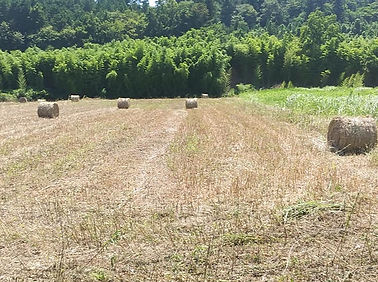
Japan’s livestock industry relies heavily on feed imported from North and South America, tending to produce high ‘food miles’—a measure of environmental burden based on the distance and quantity of food transported [note]. In our Animal Coexistence Satoyama, cows eat local wild plants, so their feed has zero food miles.
[Note] Tetsuya Nakata, Food Mileage: New Edition—Your Food Changes the Planet (Nippon Hyoron Sha, January 2018)
10
Lower Animal-care Costs
Once land is available, abundant wild plants provide feed for the cows at no cost. For winter, when fresh grass dies back, we preserve wild forage from abandoned fields in summer, keeping costs low through self-sufficiency. This also saves labour. Care costs can be around one-third to one-tenth of those in conventional dairy farming.


11
Joyful Farming
Farming happily alongside animals that live well in environments suited to their natural needs also benefits the people doing the farming.

